Anúncios
You want games that reward planning, foresight, and clever adaptation. The best strategy games for thinking players challenge your decision-making, force you to weigh trade-offs, and deliver meaningful consequences for each choice.
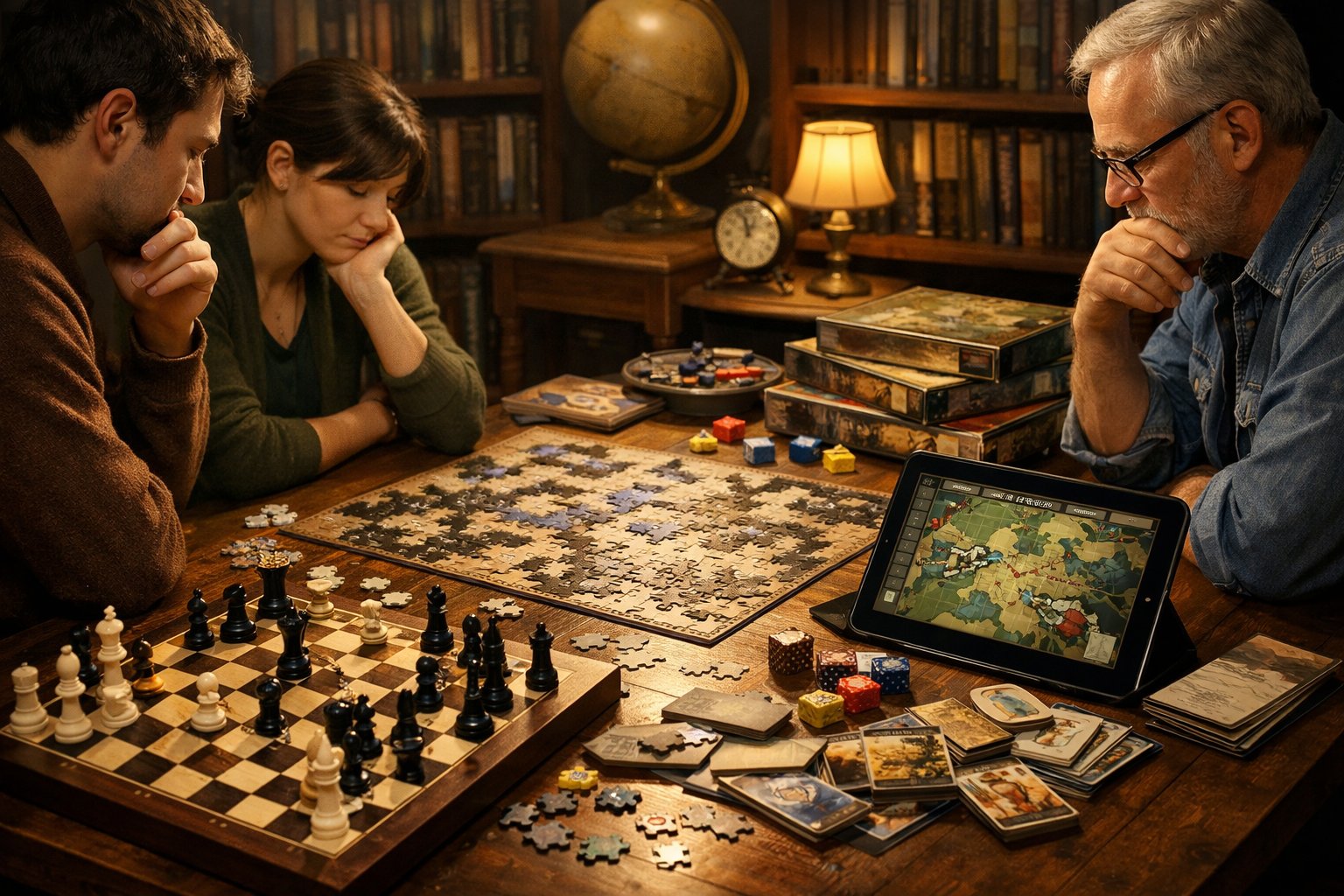
This article shows what makes a game mentally demanding, highlights classic and modern options across digital and board formats, and offers practical tips to sharpen your strategic skills through play. You’ll get clear recommendations and criteria so you can pick games that match how you like to think and improve.
What Defines a Strategy Game for Thinking Players
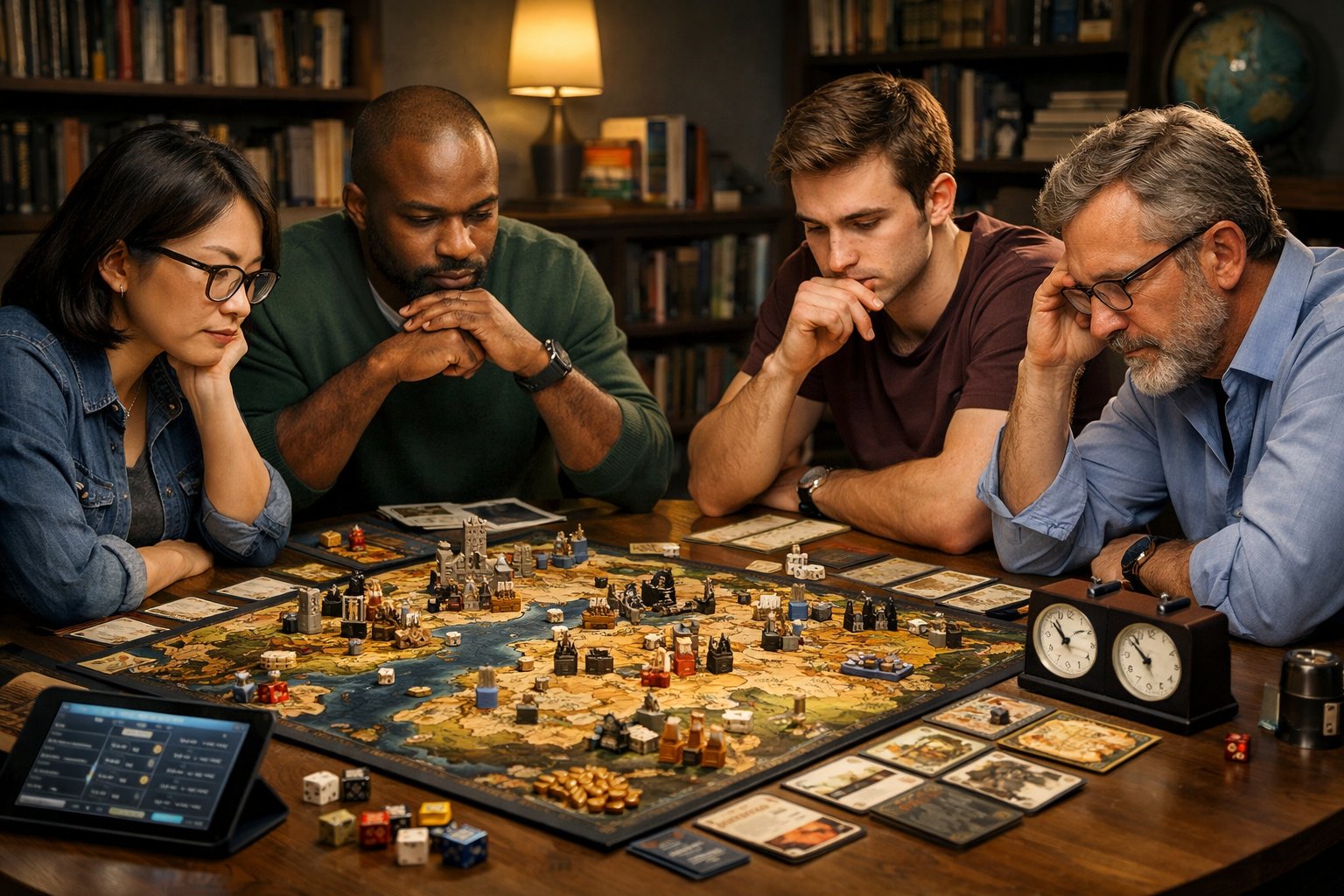
These games reward careful planning, adaptation, and analysis. Expect systems that present meaningful trade-offs, imperfect information, and consequences that scale with your decisions.
Key Elements of Strategic Gameplay
A clear set of rules with deep interactions sits at the core. You need mechanics that combine resources, positioning, timing, and unit or card abilities so choices have long-term effects rather than instant outcomes.
Games for thinking players prioritize meaningful trade-offs. For example, choosing between short-term resource gain and long-term map control should shape subsequent turns. Randomness can exist, but it should be mitigated by player choices and provide opportunities for skill to dominate luck over a series of plays.
Decision density matters: each turn or action should present several viable options. That creates a landscape where planning, reading opponents, and sequence optimization matter. Clear feedback and predictable systems let you evaluate strategies and learn from mistakes.
Types of Thinking Skills Required
Pattern recognition and forward planning rank high. You must see developing motifs—like recurring board positions or opponent tactics—and plan several moves ahead to exploit them.
Risk assessment and probabilistic reasoning help when outcomes include uncertainty. You’ll weigh expected values, consider variance, and decide when to hedge or commit. Resource management and tempo control require numeric intuition: balancing income, supply, and action economy often decides games.
Adaptability and opponent modeling are essential social-cognitive skills. You interpret signals, test hypotheses about opponent plans, and adjust. Tactical calculation (short sequences) and strategic foresight (long-term goals) work together; strong play blends both.
Differences from Other Game Genres
Strategy games differ from action games by emphasizing deliberation over reflexes. Success hinges on planning, not hand-eye speed, so time pressure is often looser or turn-based to favor thought.
They contrast with pure puzzle games by involving opponents or dynamic systems. Puzzles have a single solvable state; strategy games present moving targets, hidden information, and adversarial adaptation that force ongoing reevaluation.
Compared with party or storytelling games, strategy titles prioritize quantifiable systems and balanced mechanics. Social interaction matters, but the core challenge is navigating systemic constraints—economies, map control, fleet composition—rather than improvising dialogue or relying primarily on bluffing.
Top Classic Strategy Games for Mental Challenge
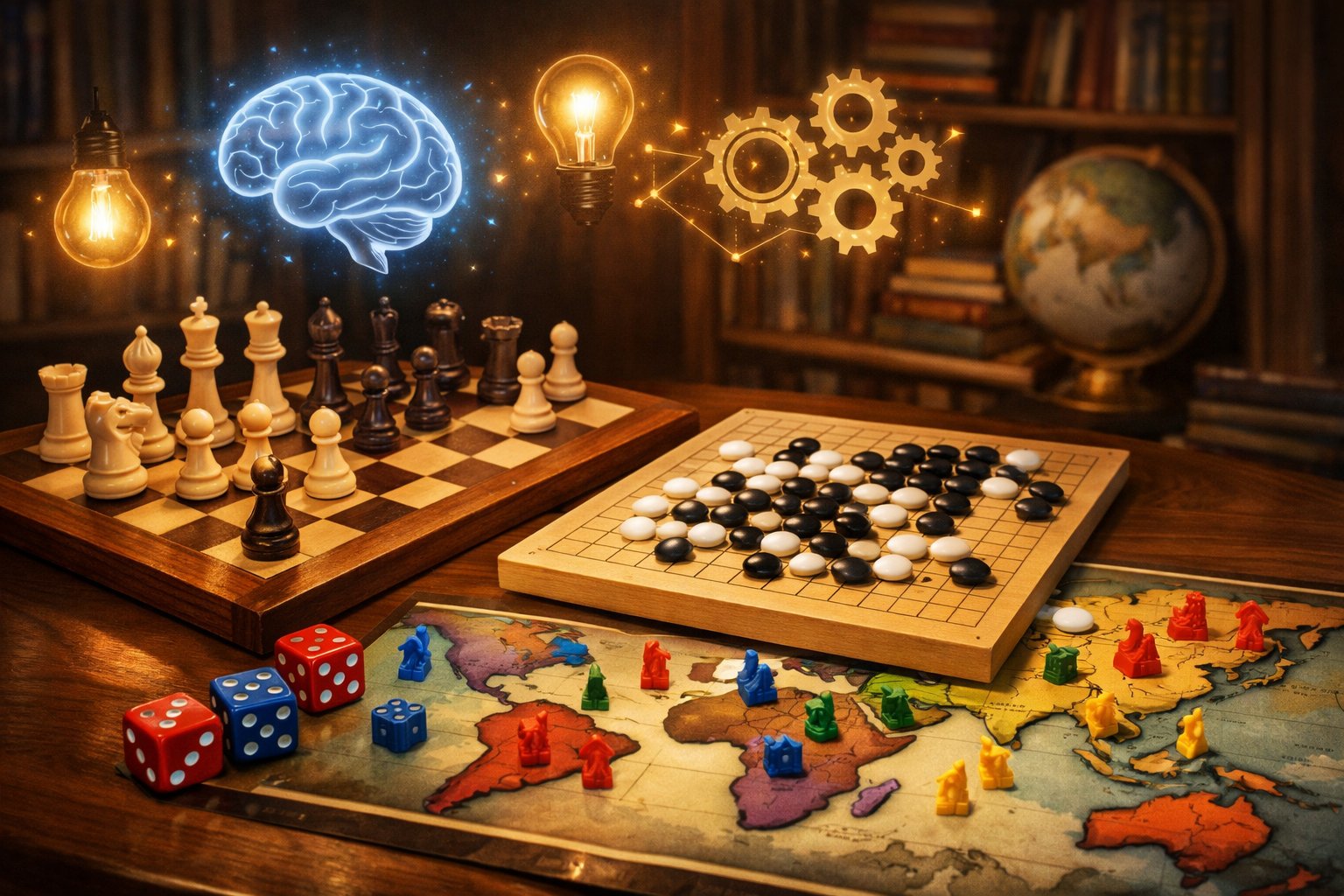
These games test pattern recognition, long-term planning, and decision trade-offs. Each demands different cognitive skills: calculation and tactics, spatial intuition and reading ahead, or macro-level planning and resource management.
Chess and Its Cognitive Demands
Chess sharpens calculation, visualization, and sequential planning. You practice calculating multiple-move variations, evaluate positions by material and pawn structure, and learn to convert small advantages into wins.
Tactical motifs — forks, pins, skewers — train short-term pattern recognition. Endgame study builds precise technique and improves your ability to plan under constrained material.
Chess also develops decision-making under time pressure. Playing with clocks forces you to balance depth of analysis against practical time management. Studying annotated master games gives concrete models for strategic concepts like prophylaxis, weak squares, and piece coordination.
Go: Mastering Simplicity and Depth
Go rewards reading large-scale patterns and balancing local fights with global influence. You place stones to control territory and shape; small local sacrifices often produce broader shape advantages.
The game emphasizes spatial judgment and long-term sente/gote considerations rather than short tactical combos. Mastery comes from recognizing joseki, connecting and cutting, and strong vs. weak group assessment.
You improve intuition through hundreds of board configurations, not just rote calculation. Modern AI tools and tsumego problems let you practice life-and-death situations and whole-board strategy, reinforcing pattern recognition and efficient shape-building.
Sid Meier’s Civilization Series
Civilization combines long-range planning with adaptive tactical decisions across dozens of systems. You manage cities, technology trees, diplomacy, culture, and military operations simultaneously.
Successful play requires prioritizing research, expansion, and infrastructure while responding to rivals’ strategies and random events. You learn trade-offs: rapid expansion can strain happiness and production; focusing research can leave you militarily vulnerable.
Victory conditions force you to choose coherent strategic goals — domination, science, culture, or diplomacy — and align city specialization, policy choices, and unit composition to that aim. Replayability and varied civilizations teach adaptive planning and scenario evaluation.
Modern Digital Strategy Game Standouts

These selections highlight different kinds of strategic thinking: tactical decision timing, constrained puzzle optimization, and long-term political maneuvering. Each title demands careful resource use, risk assessment, and learning from failures.
XCOM: Tactical Combat and Planning
XCOM forces you to weigh risk versus reward every mission. You manage a small squad where positioning, cover, and sightlines determine survival. Fog of war and limited intel force you to invest in recon and choose when to advance or withdraw.
Your roster management matters as much as battlefield tactics. You name, equip, and level soldiers; permadeath makes each choice meaningful. Research and base construction create strategic trade-offs between tech, defense, and soldier training.
The game tests your planning across multiple layers. Tactical maps present varied terrain and emergent threats, while the campaign layer supplies political pressure, funding choices, and satellite coverage decisions. You learn to prioritize short-term gains versus long-term program development.
Into the Breach: Innovative Puzzle Strategy
Into the Breach compresses tactics into small, transparent puzzles where every action has clear consequences. You see enemy moves before you act, letting you plan precise counters that protect civilian infrastructure and minimize collateral damage. The game rewards foresight and pattern recognition.
Each mech team has unique abilities that interact with predictable enemy behavior. You juggle movement, terrain manipulation, and cooperative attacks to force enemies into lethal positions or push them off cliffs. Resource scarcity and mission penalties make efficiency crucial.
Meta-progression shapes your choices between missions. Unlockable pilots and mechs expand options, but the core challenge remains optimizing limited actions. You practice optimal sequencing, sacrifice planning, and contingency setups in a compact, repeatable format.
Crusader Kings III: Grand Strategy Intricacies
Crusader Kings III shifts focus to dynastic survival and soft power. You control a ruler whose personality, relationships, and succession laws drive strategy. Intrigue, marriage alliances, and vassal management create a web of leverage you must navigate.
You balance internal stability with territorial expansion. Council appointments, legal reforms, and cultural conversion affect levy sizes and loyalty. Wars require careful casus belli use, supply-line thinking, and coalition management rather than pure battlefield tactics.
Roleplaying mechanics deepen decision-making. Characters’ traits influence diplomacy and rebellion risk, so you cultivate heirs, arrange marriages, and orchestrate plots. Long-term planning centers on succession security and legacy-building across generations.
Board Games to Sharpen Strategic Thinking
These games train different strategic muscles: resource allocation and bargaining, long-term spatial planning with asymmetric powers, and coordinated crisis management under pressure.
Catan: Resource Management and Negotiation
Catan forces you to balance production, expansion, and trade every turn. You place settlements and roads to access specific resources—wood, brick, sheep, wheat, and ore—and you must prioritize which resources to pursue based on the board layout and your development goals.
Trading is central. You negotiate with opponents to convert excess into shortages, deciding when to give up immediate value for longer-term position. Blockades and the robber introduce tactical disruption; you adapt by shifting build plans or targeting ports for better conversion rates.
You also manage probability. Hex numbers guide where to settle; you weigh frequency of rolls against resource diversity. Development cards add uncertainty and possible swing effects, so you keep contingency plans like alternate build paths and saved resources for sudden opportunities.
Terra Mystica: Complex Planning Dynamics
Terra Mystica emphasizes territory control, engine building, and asymmetric faction abilities. You choose a faction with unique terrain conversion rules and growth patterns, then plan multi-turn strategies to terraform, build, and advance on cult tracks for endgame scoring.
Spatial optimization matters. You expand to create contiguous territories for bonuses, balancing immediate returns with long-term power growth. Upgrading buildings and using workers, priests, and power cycles requires tight resource sequencing; a single misstep can stall your engine.
Interaction is indirect but meaningful. You compete for useful spaces and scoring tiles, so you read opponents’ plans and block critical expansions. Timing of actions—when to push for scoring or hoard resources—decides winners, making foresight and flexibility essential.
Pandemic: Cooperative Problem Solving
Pandemic trains you to coordinate under evolving threats. You play as specialists with unique abilities and share a hand-limited resource pool; you must allocate roles and actions to treat outbreaks, build research stations, and discover cures before disease spread overwhelms the board.
Decision-making under pressure is constant. You prioritize which cities to stabilize, when to shuttle players via research stations, and when to use event cards. The infection deck’s randomness forces contingency planning and risk assessment to avoid cascading outbreaks.
Communication and role synergy determine success. You plan multi-turn sequences—who moves where and which actions to sacrifice—to set up cures. The game rewards preemptive containment and efficient use of actions rather than reactive firefighting.
Tips for Improving Strategic Skills Through Gaming
Focus on targeted exercises, deliberate practice, and constructive review to sharpen pattern recognition, risk assessment, and adaptive planning. Apply concrete drills, timed decision practice, and postgame analysis to make steady, measurable gains.
Developing Analytical Thinking
Break complex game states into smaller components: unit composition, resource flow, and opponent intent. Create a checklist you consult during play — for example: current economy, opponent threat level, tempo, and available tech paths.
Practice postgame breakdowns by replaying critical moments and annotating why you chose one move over another. Look for recurring decision patterns and the specific information you missed.
Use drills that isolate single skills. Run opening-only sessions to master early priorities, or play puzzle scenarios that require precise calculation (e.g., chess endgame problems, supply-line optimizations).
Record metrics: win rate from specific openings, average resource deficit at midgame, or decision time for key choices. Track improvement monthly and adjust drills to target persistent weaknesses.
Practicing Decision-Making Under Pressure
Simulate realistic pressure by adding constraints: shorter time controls, limited information (fog of war), or handicaps like fewer starting resources. These settings force prioritization and reduce overanalysis.
Practice “forced-choice” rounds where you must pick between two plausible moves within a strict time budget. Review outcomes to learn which trade-offs produce better long-term positions.
Train physiological and cognitive control to keep decisions steady under stress. Use short breathing routines between games, and practice focus exercises (e.g., 5-minute concentration sprints).
Create a checklist for pressure moments: (1) identify threats, (2) list available counters, (3) estimate risk vs. reward, (4) choose and commit. Repeating the checklist under time pressure builds automatic, effective responses.
Learning from Defeat
Treat losses as data, not reflections of ability. After each defeat, write a short postgame report that lists three concrete mistakes, one missed opportunity, and one actionable change to try next time.
Compare your report with replays or opponent moves to confirm which observations are accurate. Prioritize changes that address the highest-frequency errors first.
Join a study group or find a coach to get external perspectives on losses. Use structured formats: submit a 5–10 minute clip focusing on a key error and ask for specific fixes.
Implement one change per week and test it over multiple games. Tracking outcomes prevents over-adjusting and lets you measure which lessons genuinely improve your strategic play.