Anúncios
You need mobile games that fit pockets of free time without demanding long commitments. Choose titles with quick rounds, fast save/resume, and meaningful progress in minutes so you can enjoy play between errands, commutes, or short breaks.
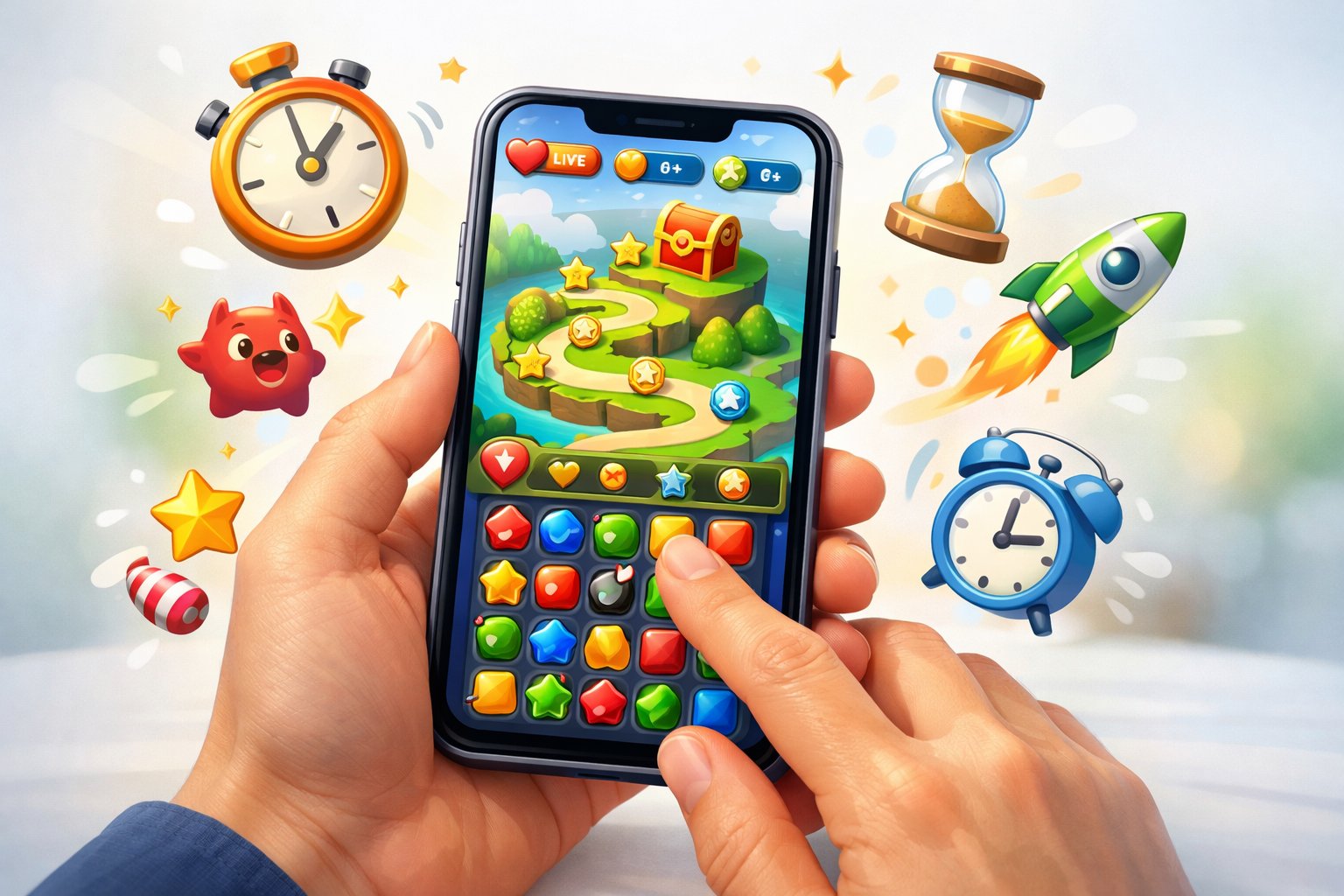
This article highlights compact, satisfying games across genres, explains the features that make them great for short sessions, and suggests how to get the most fun from brief play. Expect clear recommendations you can launch immediately when you have five to fifteen minutes.
Top Picks for the Best Mobile Games for Short Play Sessions
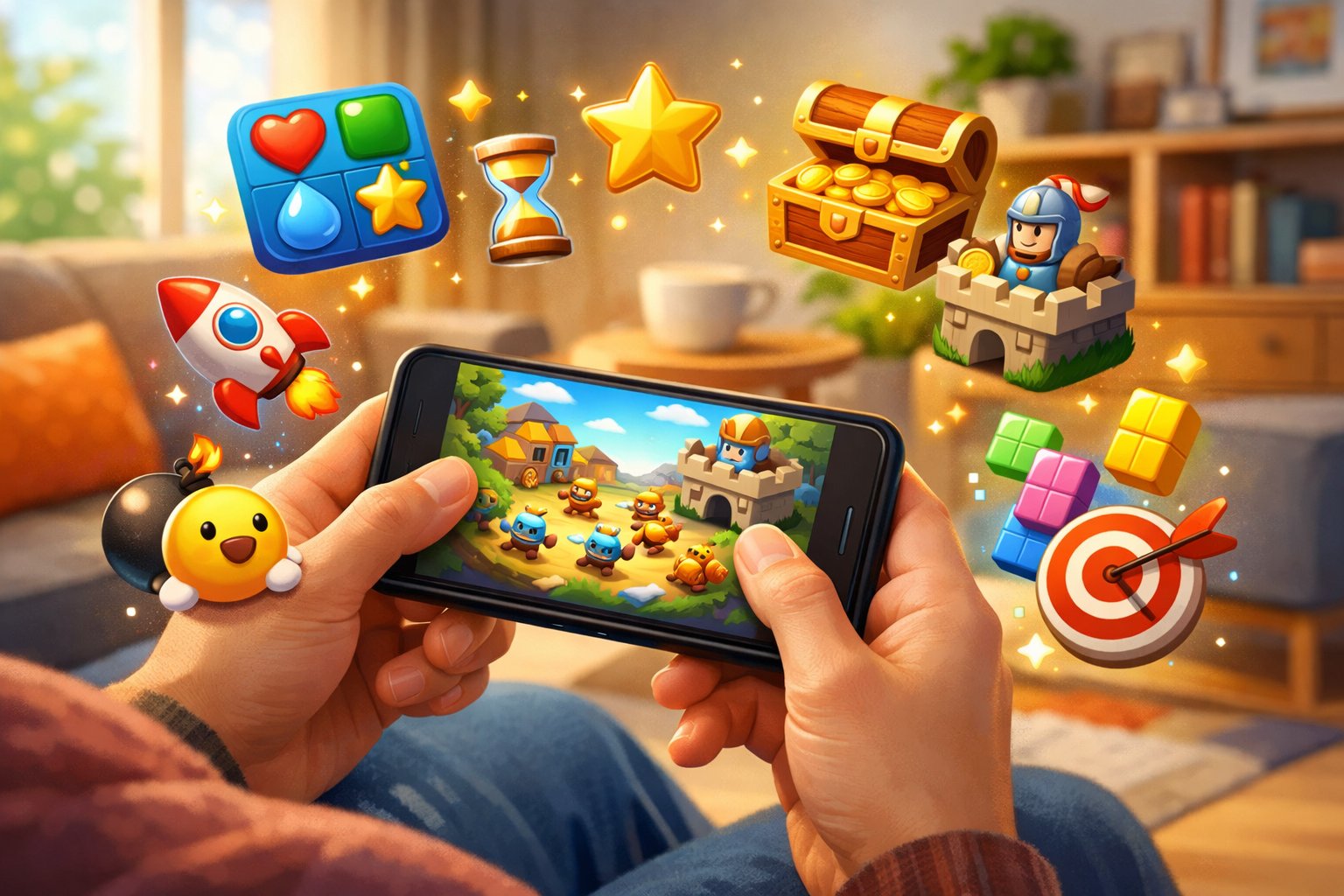
These picks focus on games that deliver satisfying progress, clear objectives, and minimal load times. You’ll find options that fit quick commutes, coffee breaks, or waiting in line.
Casual Puzzle Games
Casual puzzle games give you short, complete challenges that don’t require long-term commitment. Examples include Candy Crush Saga, Two Dots, and Threes!, each offering levels that take 1–5 minutes and clear visual cues for goals.
Look for titles with level-based progression, daily challenges, and offline play so you can finish rounds without a network connection.
Pay attention to difficulty pacing: good puzzle games gradually introduce mechanics so you can make meaningful progress in one session.
If you prefer depth, try Baba Is You or Mini Metro for slightly longer puzzles that still respect bite-sized play.
Use features like one-tap controls, autosave, and instant retries to avoid wasting time on menus or long reloads.
Fast-Paced Action Titles
Fast-paced action games reward quick reflexes and short match lengths. Examples: Into the Dead 2, Supercat Tales, and Jetpack Joyride deliver runs that often last under a minute to a few minutes.
Choose games with simple control schemes—tap, swipe, or tilt—so you can jump in immediately.
Look for roguelite runs or arcade scoreboards to make each short session feel meaningful; leaderboard and daily objectives add replay value without long commitments.
Check for low load times and small installs if storage or patience is limited.
Avoid action games with long cooldowns or forced waiting screens; they break the flow of short sessions.
Relaxing Idle Clickers
Idle clickers let you make progress with minimal active time, ideal when you have only a minute or two to spare. Popular examples include AdVenture Capitalist, AFK Arena (idle mode), and Egg, Inc.
You can tap a few times to collect rewards and then let the game run in the background, returning later to claim upgrades.
Prioritize games that offer meaningful automation upgrades, offline earnings, and clear upgrade paths so brief interactions feel rewarding.
Watch for excessive ads or paywalls that interrupt short sessions; good idle games balance monetization without forcing frequent manual actions.
Use quick menus for prestige or reset options so you can plan longer progression during short bursts.
Quick Competitive Multiplayer Games
Quick competitive games focus on short matches and immediate matchmaking. Titles like Clash Royale, Brawl Stars, and Among Us (shorter rounds) provide matches typically between 2–7 minutes.
Pick games with skill-based matchmaking and rematch options to avoid long waits between rounds.
Look for clear tutorials and small team sizes so you can contribute meaningfully in a single session.
Competitive modes with ranked ladders or daily rewards keep short sessions meaningful while limiting grind.
Ensure the game handles poor connections gracefully and offers quick reconnection or spectate options so a dropped match doesn’t waste your time.
Key Features of Games Ideal for Short Play Sessions
You want games that fit into brief pockets of time without friction. Prioritize play segments, fast state handling, and loading behavior that gets you back into action immediately.
Short Game Rounds
Short rounds let you finish meaningful progress in 1–5 minutes. Look for titles with discrete objectives per session — for example, level-based match-3 puzzles that end after one board, roguelite runs capped by a single encounter, or card-battlers where one hand decides the outcome. These formats avoid long commitments and make it easy to pick a stopping point.
Design elements matter: clear win/lose conditions, predictable round length, and scalable difficulty so you rarely need multiple retries. Also value games that give small rewards per round (XP, currency, card packs) so each short play feels productive.
Instant Save and Resume
You need reliable state persistence that restores your exact progress when you return. Prefer games that auto-save after every action or at natural checkpoints, not just on exiting to the menu. This prevents lost progress if a call interrupts you or battery dies.
Resume behavior should be immediate and context-aware: restore match state or open the same level, and avoid forced replays of unskippable cutscenes. If a title offers cloud sync, check how quickly it reconciles progress across devices to avoid conflicts when you switch phones.
Minimal Load Times
Load times directly cost the few minutes you have available. Choose games that load the main menu in under 5 seconds and jump into gameplay within 10 seconds on typical devices. Progressive asset streaming that shows UI while loading background content helps you start actions sooner.
Also consider how updates and patches affect short sessions. Games that apply small, incremental downloads or let you play during background updates preserve short-play usability. Avoid titles that require long post-update resynchronization or heavy asset unpacking before each session.
Recommended Games by Genre

These picks focus on short, satisfying sessions you can finish between tasks. Each game listed emphasizes quick rounds, easy resume, and meaningful progression so you spend seconds to minutes, not hours.
Arcade Standouts
Jetpack Joyride — Fast one-touch runs with short checkpoints and clear goals. Sessions last a minute or two, and daily challenges give bite-sized objectives that reward progression without long commitment.
Downwell — Vertical descent with tight controls and short runs. You can complete a run in several minutes; the roguelike structure keeps each attempt distinct and instantly replayable.
Into the Dead 2 — Short survival sequences against zombies; missions are segmented so you can play single objectives without launching long campaigns. Controls are simple and load times are minimal.
Crossy Road — Each crossing is a compact round you can finish quickly. High scores encourage repeat plays, and local saves mean you can pick up right where you left off.
Card and Strategy Highlights
Slay the Spire — Runs take longer than pure arcade games but you can still achieve meaningful progress in short bursts by focusing on single-act climbs. Deck-building choices feel impactful within each run, making 20–40 minute sessions optional rather than required.
Hearthstone — Matches average under 10 minutes. Ladder and Arena modes let you opt for quick casual play or short ranked games depending on your time window.
Reigns — Decision-based, swipe mechanics create very short sessions. Each card swipe changes kingdom stats and completes discrete events, making this game perfect for 1–5 minute breaks.
Card Thief — A stealth card game designed for concise runs. Levels take a few minutes and require tactical decisions, giving satisfying depth without long play commitments.
Simulation Experiences
Stardew Valley (Mobile) — You can play short in-game days or handle a few farm tasks in 10–15 minutes. Save anywhere and resume later; progression remains steady even with fragmented play.
Mini Metro — Build transit networks in sessions that you can pause between days. Each game stage lasts several minutes and scales in complexity, making it easy to stop at logical breakpoints.
Plague Inc. — A full run can be longer, but you can complete focused attempts like testing a single strategy within short windows. Auto-save between runs ensures you won’t lose progress.
Pocket City — City-building with quick tasks and short play loops. You can implement zoning changes, respond to events, and watch immediate results in brief sessions.
Benefits of Playing Games in Short Sessions
Short sessions can sharpen specific skills quickly and fit into tight schedules. They let you get measurable progress without committing large blocks of time.
Boosting Mental Agility
Playing puzzle, word, or reaction-based mobile games for 5–15 minutes repeatedly strengthens pattern recognition and decision speed. You train neural pathways that handle quick judgments: for example, matching-tile games improve visual scanning, while timed trivia refines retrieval under pressure. These tasks repeatedly engage working memory, which helps you hold and manipulate small amounts of information during other daily tasks.
Use variety to target different cognitive skills. Alternate between logic puzzles, sequencing challenges, and fast reflex games across sessions. Track simple metrics—best time, accuracy, level reached—to notice incremental improvement and adjust difficulty so the challenge stays productive.
Reducing Stress on the Go
Short game sessions act as controlled interruptions that lower immediate stress without creating distraction later. A 3–10 minute session of a calming puzzle or low-stakes strategy game can reduce heart rate and shift focus away from a stressful email or commute. You regain composure faster than with prolonged browsing or social media scrolling.
Choose games with predictable, satisfying feedback and clear session end points. Examples: a daily crossword, a 7-minute meditation-style puzzle, or a single quick race in a racing game. These let you decompress in a measurable way and return to tasks with clearer attention.
Tips for Enjoying Mobile Games in Quick Sessions
Control session length, reduce interruptions, and tune settings so each short play feels satisfying. Prioritize objectives, silence distractions, and keep battery and data use in check.
Managing Screen Time
Set a strict timer for 5–15 minutes depending on how much focus you have. Use your phone’s built-in Screen Time (iOS) or Digital Wellbeing (Android) to create an app limit specifically for games, and enable a lock after the limit expires.
Plan a single, clear goal before you open the game — finish one run, reach a checkpoint, or earn a short reward. Avoid open-ended modes like free roam or long multiplayer matches when you only have a few minutes.
Manage notifications: turn off in-game alerts or use Do Not Disturb for the short window you play. If you rely on achievements, enable only critical notifications so nonessential pop-ups don’t steal time.
Keep sessions consistent by scheduling them at the same times each day—waiting room, commute, or coffee break. Consistency helps you get meaningful progress without letting playtime expand unexpectedly.
Optimizing In-App Settings
Lower graphical settings to reduce load times and extend battery life; drop effects, shadows, and frame rate if the game lets you. Faster load and smoother performance mean you spend more of your short session playing and less waiting.
Enable “quick resume” or “instant play” features when available, and set the game to skip intros and cutscenes. If the game supports single-button actions or simplified controls, use them to reduce the number of taps needed for meaningful results.
Adjust audio and haptics: mute music or vibrations that slow your reaction or drain battery. Keep sound effects for feedback if they help you play faster, and disable cloud sync during sessions if it causes stutters.
Use data- and battery-saving modes when you’re away from power or on limited data. Pre-download content and updates over Wi‑Fi so short sessions aren’t interrupted by mandatory downloads.