Anúncios
You can improve at competitive online games by focusing on a few clear, repeatable practices: pick a game that fits your goals and play style, learn the core mechanics thoroughly, and structure practice so you steadily close gaps in skill. Targeted, consistent practice combined with smart habit changes and a growth mindset will produce visible improvement faster than random play.

This guide shows how to choose the right game, build solid fundamentals, develop strategy and tactics, optimize practice sessions, and create habits that support long-term progress. Use the steps here to turn casual sessions into purposeful improvement and make steady gains you can track.
Choosing the Right Competitive Online Game
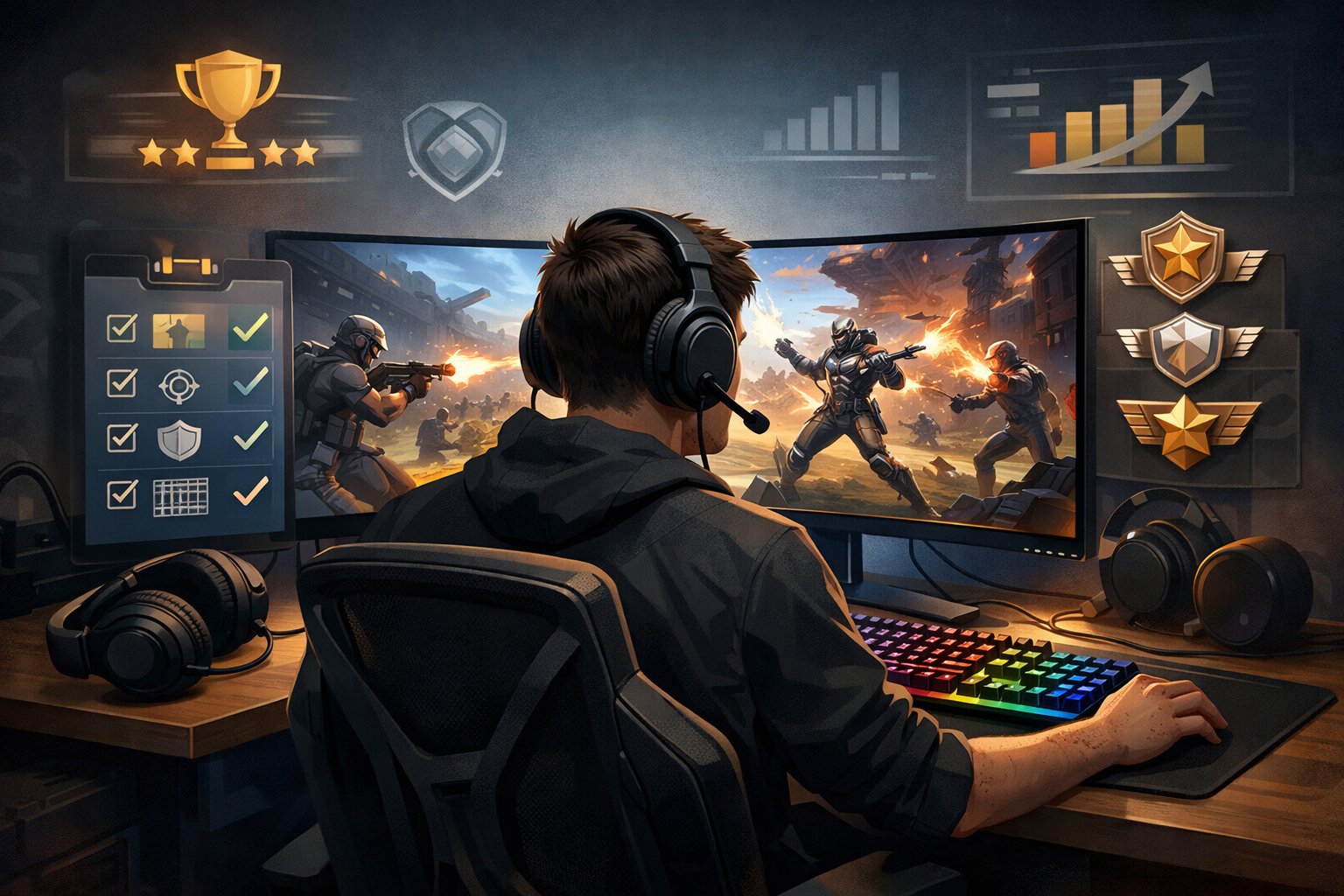
Pick a game that fits how you like to play, the hardware you own, and the kind of community you want to join. Prioritize mechanics you enjoy, platform compatibility, and active support to make steady improvement realistic.
Assessing Genre Preferences
Identify the game genres that match skills you already enjoy using. If you prefer fast reaction and aiming, consider first-person shooters (e.g., CS2, Valorant). If you like pattern recognition and macro planning, look at MOBAs (e.g., League of Legends, Dota 2) or RTS titles.
Think about time investment per session. MOBAs and RTS games usually require longer matches and higher strategic depth. Arena shooters or fighting games often offer shorter matches and quicker learning cycles.
Test a few free-to-play options or watch high-level streams for 1–2 hours each to sense the pace and core mechanics. Make a short checklist: mechanical skill requirement, teamwork reliance, match length, and learning resources. Use that checklist to rank three candidate games before committing.
Evaluating Platform and System Requirements
Confirm the platforms supported: PC, console, or mobile. Competitive parity matters—PC often gives precise input options (mouse+keyboard) while console and mobile may use aim assists or touch controls that change skill ceilings.
Check minimum and recommended specs on the game’s official site and compare them to your hardware. Pay attention to CPU, GPU, RAM, and network requirements (recommended FPS and latency targets).
Consider input devices and peripherals you already own. For PC shooters, a stable 120+ FPS and a wired mouse are highly beneficial. For fighting games, decide between controller and arcade stick—consistency matters more than which you choose. Budget for incremental upgrades only if the game’s competitive scene justifies them.
Understanding Community and Support
Investigate the player base size, ranked system integrity, and developer responsiveness. A healthy competitive scene has regular balance patches, transparent roadmap updates, and reliable anti-cheat measures. Check patch notes frequency and official communication channels.
Read community hubs—Reddit, official forums, and Discords—to gauge toxicity, improvement resources, and local or regional activity. Look for structured learning tools like in-game replays, coaching integrations, or robust third-party stat trackers.
Prioritize games with active tournament ecosystems if you plan to compete. Smaller communities can be welcoming but may lack consistent matchmaking quality. Choose a game where both community behavior and developer support align with your improvement goals.
Mastering Game Fundamentals

You’ll build consistent results by understanding how the game works, optimizing input and display settings, and reading the HUD quickly. Focus on specific mechanics, refine controls for precision, and learn which UI elements convey critical information during fights.
Learning Core Mechanics
Identify the game’s primary systems: movement, damage calculation, resource management, cooldowns, and hitboxes. Read official patch notes and weapon/ability tooltips to learn exact numbers and interactions.
Practice one mechanic at a time. For example, isolate recoil patterns in a private match, then add target tracking. Track improvement by measuring hit percentage or time-to-kill.
Learn priority rules: what interrupts what, which abilities pierce shields, and how armor vs. damage type alters outcomes. Use a notepad or in-game keybinds to mark combos and counters. Watch short clips of pro players using the same role to see timing and positioning choices in context.
Practicing Controls and Settings
Start by optimizing input latency: set polling rate, reduce in-game mouse smoothing, and enable raw input if available. Confirm your system runs the target frame rate; lower unnecessary graphics settings to maintain stability.
Customize keybinds so high-frequency actions sit under comfortable fingers. Avoid shifting long distances for essential inputs. Use consistent sensitivity across games only if it transfers well; otherwise tune per title.
Create focused drills: aim trainers for accuracy, custom matches for movement, and scripted macros for muscle memory (where allowed). Log settings and test changes in short sessions; revert any tweak that worsens consistency. Back up your config file after you settle.
Navigating User Interface Elements
Prioritize UI clarity: scale HUD elements to show health, ammo, and cooldowns without cluttering aim lines. Move or hide nonessential overlays like large chat boxes or persistent mini-maps that block sightlines.
Learn color and icon language. Memorize enemy indicators for low-health, shielded, or stealthed states. Map common alerts to peripheral vision—place timers and reticle buffs near screen center to reduce eye movement.
Use quick-reference aids: a small table of key HUD elements and their meanings helps during practice.
- Health bar: color, thresholds, and regeneration rules
- Cooldown timers: number vs. radial fill conventions
- Objective markers: friend vs. foe symbols
Check how UI scales across resolutions and remap any obstructive element before competitive play.
Developing Strategic and Tactical Skills

Master map control, objective timing, opponent patterns, and split-second tradeoffs to make smarter plays. Focus on repeatable routines: map routes, timing windows, read patterns, and simple decision rules you can apply under stress.
Studying Maps and Objectives
Learn exact spawn points, chokepoints, high-ground spots, and common rotation routes for each map you play. Memorize timings for major objectives (e.g., Baron/Dragon timers, bomb plant windows, capture point respawns) so you know when to force fights or back off.
Create a short checklist for each map: safe routes, aggressive angles, rotation time to objective, and common vision denial spots. Drill those routes in practice mode or low-pressure matches until movement and timing feel automatic.
Use a map overlay or notes to mark priority vision zones and objective windows. Review game replays to compare where you should have been versus where you were, then adjust routes and timing accordingly.
Analyzing Opponent Behavior
Track opponent tendencies across matches: preferred lanes/roles, aggression frequency, ultimate cooldown usage, and common bait setups. Note specific player habits—e.g., “top laner overextends after hitting level 6″—and write them down for quick reference during the match.
Use short, actionable tags in your notes like: “pushes early,” “ignores vision,” or “peels in teamfights.” During the game, convert observations into predictions: where they likely rotate, when they will commit, and which windows they leave exposed.
Watch replays to find patterns in decision moments: how opponents react to pressure, their pathing when low on resources, and when they risk objectives. Turn those patterns into concrete counters you can execute without hesitation.
Improving Decision-Making Under Pressure
Practice a small set of decision rules you follow when under stress, such as: (1) check objective timer, (2) assess vision, (3) evaluate HP/resources, (4) decide engage/retreat. Relying on a checklist reduces panic and speeds up consistent choices.
Simulate pressure with shorter time controls in custom games or set specific constraints (e.g., limited abilities, forced rotations) to rehearse choices. After each session, log one decision that went well and one that failed, then note the rule that would correct the failure.
Keep decisions simple and prioritized: survival first, objective second, risk only if win probability >60%. Use numeric cues—HP thresholds, cooldown seconds, teammate distance—to remove ambiguity from split-second calls.
Optimizing Practice and Progression
You will set clear, measurable targets, build routines that force deliberate improvement, and track the right stats to know what actually changes. Focus on specific skills, time management, and data that tie directly to wins and decision quality.
Setting Achievable Goals
Break long-term aims into concrete short-term targets you can measure weekly. For example: “Improve 1v1 win rate from 48% to 52% in six weeks” or “reduce average ability-cooldown misuse from 6 to 3 per match in four weeks.”
Use SMART criteria: Specific, Measurable, Achievable, Relevant, Time-bound. Write goals in a simple format: Goal — Metric — Deadline. Revisit goals every week and adjust based on progress or schedule changes.
Prioritize two to three goals at a time to avoid scattered focus. Assign each goal a practice method and a verification method (replay review, match stats, or coach feedback). Celebrate small wins to keep motivation steady.
Implementing Effective Practice Routines
Structure sessions into warm-up, focused drills, and review. Warm up with aim/accuracy or warm-up maps for 10–15 minutes. Spend the main block (45–60 minutes) on one targeted skill, such as map control, trading, or mechanical combos.
Use deliberate practice: isolate the sub-skill, set a performance target, get immediate feedback, and repeat until you hit consistency. Rotate skills by day so you maintain variety without losing depth.
End with 10–20 minutes of review: save replays, note three mistakes, and script corrective drills. Keep total daily practice under 2.5 hours to avoid mental fatigue and preserve match-quality.
Tracking Performance Metrics
Track metrics that directly reflect the skills you train. Examples: kill/death ratio, objective time, damage per minute, utility accuracy, clutch conversion, reaction time, and decision delay on replays. Choose 4–6 core metrics that map to your goals.
Log results after each session in a simple table or spreadsheet: Date | Activity | Metric1 | Metric2 | Notes. Update trends weekly and highlight variance greater than 10% for investigation. Use visuals—charts or sparklines—to spot plateaus quickly.
Combine quantitative metrics with qualitative notes from replay review. Mark recurring mistakes and link them to drills. If a metric improves but win rate does not, inspect team-dependent factors before changing your practice plan.
Building Positive Habits and Mindset
You will adopt routines that reduce emotional swings and keep practice productive. Small, repeatable actions and realistic expectations protect your focus and help you improve steadily.
Managing Frustration and Tilt
Recognize the physical and mental signs of tilt: clenched jaw, quickened breathing, tunnel vision, or repeated reckless plays. When you notice these, stop play immediately or switch to low-stakes tasks (warmup, aim trainers, or reviewing replays) to reset your state.
Use a short ritual to break cycles: deep breaths for 30–60 seconds, a 5-minute walk, or a drink of water. Log the trigger and outcome once per session in a simple note so patterns become visible over time.
Set micro-goals for matches: focus on one mechanical or decision target (e.g., consistent crosshair placement, or avoiding early fights). That narrows attention and reduces blame-focused thinking after losses.
Apply a structured cooldown after a bad game: 10 minutes of non-game activity, then a brief review of one clear takeaway. That prevents emotion-driven revenge plays and keeps practice deliberate.
Maintaining Consistent Motivation
Pinpoint why you play: list specific short-term aims (rank milestone, role mastery, consistent 60% win rate in duos). Replace vague goals with measurable targets you can track weekly.
Build a weekly practice plan with fixed blocks: two focused skill sessions (60–90 minutes each), three short play sessions (30–45 minutes), and one review session (30 minutes). Treat these blocks like appointments you can’t skip.
Use progress tracking tools: a spreadsheet of match stats, replay timestamps for mistakes, or a simple habit tracker app. Review metrics weekly to adjust effort where it yields results.
Create social accountability: schedule practice with a partner, join a small improvement-focused group, or post weekly goals in a community. External expectations boost consistency when internal motivation wavers.